


Mesh Complications Patient Story 19
TVT Sling Complication; Supra Pubic Pain
Mesh Complications: Increasing pain in the right suprapubic region and bulge vaginally
Treatment: Laparoscopic release and removal of TVT sling, Laparoscopic mesh sacral colpoopexy (For recurrent prolapse)
The Patient is a 52 year- old- female who had surgery for cystocele and stress urinary incontinence. Her original surgery included:
- TVH (total vaginal hysterectomy)
- Perigee Procedure (mesh) for cystocele
- TVT sling for urinary leakage
The patient had original surgery in 2008 for prolapse and incontinence. She did well for about a year, however, began having symptoms of recurrent bulge vaginally, bladder symptoms and pain in the vagina and the right lower quadrant of the abdomen.
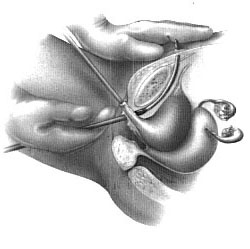
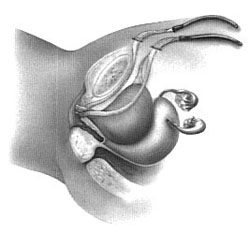
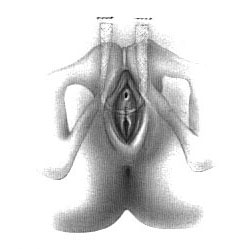
The patient came to see Drs. Moore and Miklos and was found to have vaginal vault prolapse, recurrent cystocele as well as pain in the region of the lower abdomen where the TVT sling scar was found. The arms of the Perigee could be palpated; however, there was no pain found on exam vaginally, and it did not appear the vaginal mesh or the mesh arms were part of the problem. Other than the fact, that the procedure failed, and she had recurrent prolapse.
Comment by Dr. Moore: The Perigee is a first generation mesh kit procedure designed to treat cystocele. It involves passing needles or trocars through the groins and attaching a vaginal mesh to the pelvic muscles with mesh arms. If these arms are too tight or heal under tension they can cause pain. This did not seem to case. However, the procedure did not achieve vault support and, therefore, this type of failure was seen with the procedure. This procedure has been updated and improved with the Elevate procedure as no needles are passed through the groins, no mesh arms passed through the muscles and vaginal vault support is also achieved. This patient’s pain was actually caused by the TVT sling mesh passing through the abdominal wall and pulling on this area causing the pain. The recurrent prolapse or the vagina falling and pulling on the TVT mesh also aggravated this. In this situation the mesh needs to be released away from the abdominal wall. This has to be accomplished through the abdomen as cannot be done vaginally.
Dr. Moore and Dr. Miklos took the patient to surgery and completed the entire procedure laparoscopically. They repaired the vault prolapse with a laparoscopic mesh sacral colpopexy, and then dissected down into the retro pubic space, identified the TVT mesh pulling on the abdominal wall (it was not in the correct position), released and removed the TVT mesh.
The patient recovered well. Her pain resolved, and vaginal support has been restored.
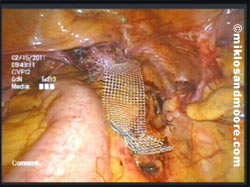
Figure 1. Mesh sacralcolpopexy for recurrent vaginal vault prolapse
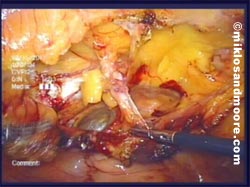
Figure2. TVT mesh tape isolated in the retro pubic space. It can be seen how it is pulling on the anterior abdominal wall.
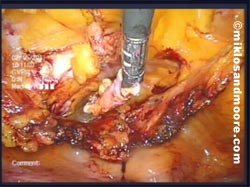
Figure 3. The TVT mesh arm has been released and cut away from the abdominal wall and the retro pubic portion of the arm has been removed. The patient remained continent after surgery, as the whole sling did not need removed.
Click here to find out more about TVT Mesh complications.
Click here for related patient stories