

Call now for a confidential consultation with Elizabeth • Atlanta: (770) 475-0862 • Beverly Hills (310) 776-7588


Sacralcolpopexy Mesh Complications

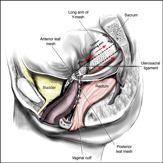
The abdominal sacral colpopexy (done through an “open” abdominal incision or laparoscopically/robotically) is the gold standard procedure to treat vaginal vault prolapse. It has the highest cure rate in the literature and has been studied for many years. It is a procedure where a Y-shaped piece of mesh is placed over the top of the vagina and down upper anterior and posterior walls of the vagina and then the other end is attached to a ligament on the sacrum. This holds up the top of the vagina, the top of the bladder and rectum. Complication rates are relatively low, however mesh complications still occur. The rates of mesh complications compared to vaginal placement of mesh seems to be lower, however it is a much more invasive operation (especially when done via laparotomy or a large open abdominal incision). Drs. Miklos and Moore recently published the largest series in the world on Laparoscopic Mesh Sacralcolpopexies and had an overall complication rate <1% (click here to see paper). However as with ANY prolapse surgery, with or without the use of mesh, complications the CAN still occur.

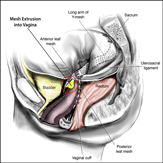
Mesh Extrusion:

As with vaginal mesh placement, mesh extrusion or exposure through the vagina can occur however typically the overall rates seem to be lower with the sacralcolpopexy procedure. Rates in the literature vary between 1 and 10%. In Drs. Miklos and Moore’s study, overall rate of extrusion was 1.1%. Some series do show higher rate of extrusion or exposure if a hysterectomy is completed at the same time secondary to the mesh being placed over the incision where the cervix was. Again, this complication is the most common, however it is a minor complication that is easily handled with a small excision and repair of the defect through an outpatient vaginal approach. An abdominal or laparoscopic approach would only be necessary if the vaginal approach did not work, or the mesh was not a Type I mesh and needed to be completely removed (such as Goretex). Drs. Moore and Miklos would accomplish this laparoscopically (see treatment section).

Sacral Colpopexy Mesh Extrusion (Gortex Mesh Graft) /
Sacral Colpopexy Mesh Extrusion (Y-Mesh Graft) / Sacral Colpopexy Mesy Abscess and Mesh Extrusion

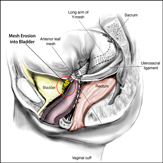
Mesh Erosion in bladder or bowel:

This is a very rare complication and in Drs. Miklos and Moore’s series of over 400 laparoscopic sacralcolpopexies, this did not occur. However, it may occur on a rare occasion and if so the mesh will need to be removed from the bowel and/or bladder. If it has eroded into the bowel a temporary colostomy may be required as well. If it is in the bladder, typically Drs. Miklos and Moore can remove this laparoscopically with only a 23 hour stay (see treatment section).

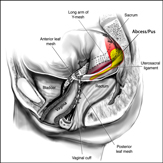
Infection or rejection of mesh:

Type I soft, polypropylene mesh almost never is the CAUSE of an infection, however if an infection occurs (ie there is a baseline risk of pelvic abscess or infection with hysterectomy of <1%) at time of hysterectomy or for another reason the mesh may need to be removed. If a sacralcolpopexy is completed at time of hysterectomy, the risk of infection is slightly higher secondary to the hysterectomy and is not due to the mesh (ie there is a risk of infection with any hysterectomy whether mesh is used or not). If a pelvic infection or abscess occurs, antibiotics may be used in attempt to cure it, however many infectious disease experts may recommend that the mesh needs to be removed for the infection to resolve as it is a foreign body that the bacteria may be adhered to. We have never seen a true rejection or allergic reaction to a Type I mesh, however if it did occur, the mesh would need to be removed. Again, most surgeons would have to do a major operation through a large abdominal incision, however Drs. Miklos and Moore remove the mesh through a laparoscopic outpatient type procedure.

Vaginal Pain or Painful Intercourse:

There is a risk of pain with intercourse in 1-4%  of patients after sacralcolpopexy. The mesh at the top of the vagina can cause some scar tissue formation or inflammation that typically improves with time, however if it does not then treatment may be necessary. Conservative therapy involves pelvic floor and vaginal physical therapy, trigger point injections, and vaginal dilators in certain cases. If this does not resolve the issue, the mesh may need to be revised or removed.


Abcess post LAVH/Sacralcolpopexy


Call now for a confidential consultation with Carrie • Atlanta: (770) 475-0862 • Beverly Hills (310) 776-7588