

Dr. John Miklos and Dr. Robert Moore – Vaginal Mesh Complication Surgeons
Internationally Renowned Vaginal and Laparoscopic Surgeons
Located in Atlanta, GA – Patients from 47 States and 45 Countries
Call now for a Confidential Consultation with Carrie (770) 475-0862Call now for a confidential consultation with Elizabeth • Atlanta: (770) 475-0862 • Beverly Hills (310) 776-7588
Vaginal Mesh Kit Complications (Prolift, Apogee/Perigee, Avaulta, Elevate)
Mesh has been used vaginally for many years, however the mesh kits were developed in the early 2000’s in attempt to try to simplify and make its placement vaginally less invasive. This led to a very wide adaptation of their use by many surgeons that may not have had much experience with graft use in the past and subsequently complications began being reported. Used correctly in the right patient population, studies have shown its use to be very effective with low rate of complications, however complications are known to occur with ANY surgical procedure no matter who is doing them or what material (if any) is used. It is probably more important to have a surgeon that is adept in not only the surgical procedure, but ALSO in recognizing the potential complications and treating them adequately if they occur.
The following complications are risks of vaginal mesh surgery:
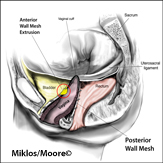
Mesh Extrusion or exposure vaginally:
This is the most common complication reported and typically considered a minor complication and one that is taken care of relatively easily with a minor surgical procedure. Vaginal mesh extrusion with mesh kits has been shown in studies to be in the range of 5 to 15%. This number has been dramatically reduced in recent years with the advent of newer, lighter, softer Type I mesh. The original studies reporting on kits such as Perigee/Apogee as well as Prolift used a much heavier mesh than is currently being used and therefore the extrusion rates were higher (in the rates of 10-15%). Mesh technology has improved and recent studies using lighter mesh has shown the extrusion rate has dropped more than 50% some cases. This also has to do with improved surgical technique and surgeon experience as well. Dissection techniques of placing the mesh deeper have also led to lower extrusion rates. Drs. Moore and Miklos recently published a study with this lighter mesh and had extrusion rates <1% (Anterior elevate AAGL abstract).
When a mesh extrusion occurs, it typically will cause vaginal discharge, bleeding or pain. In many cases the surgeon may notice this prior to the patient experiencing any symptoms as there may have been an issue in healing that caused the exposure. Extrusions that happen early may heal over with conservative therapy such as antibiotics and/or estrogen cream. If it does not heal or is a large exposure, a minor procedure involving excising or trimming the exposed mesh and repair of the defect is necessary (see treatment section).
Avaulta - Mesh Extrusion and Recurrent Prolapse /
Anterior Avaulta - Mesh Extrusion, Vaginal Pain /
UpHold Mesh Complication - Pain and Mesh Extrusion / Avaulta - Chronic Vaginal Pain, Vaginal Mesh Extrusion / UpHold Complication - Mesh Exposure, Pain with Intercourse (Husband can feel mesh)
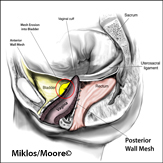
Mesh Erosion into the bladder or rectum:
This is a very rare complication, however if it does occur it will require surgical management. Symptoms can include bladder pain, blood in the urine, recurrent urinary tract infections, voiding dysfunction (urgency, frequency, painful urination, etc), fistula formation (drainage of urine or feces into the vagina), blood in the stool, abscess formation vaginally, rectal pain or other symptoms including systemic infection. This is a serious complication and needs surgical intervention (see treatment section).
Vaginal, leg and/or buttock pain:
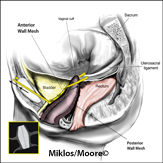
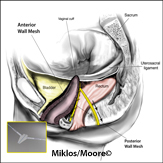
This complication can occur if the mesh is placed too tight or is pulling on the pelvic floor muscles or nerves. Occasionally, probably more so with the older mesh, contraction of the mesh could occur over time causing the mesh to tighten when it heals and therefore causing pulling and pain. Surgeons have learned to place the mesh tension-free to help minimize risk of this complication, however sometimes no matter how carefully placed, the mesh can heal in a fashion that causes this pain. The first generation kits such as Apogee/Perigee, Prolift, Avaulta and others utilized needles passed through the groins and/or buttocks to attach the arms of the graft to the pelvic floor muscles. In many cases these arms are the source of the pain as they heal too tight and cause a “band” that pulls on the muscles and causes pain. In the newer generation kits, such as the Elevate, these risks have been decreased as there are no external needle passes and no arms that penetrate through and through the levator muscles. Treatment of these type of complications involves a surgical procedure to release or remove the mesh causing the pain (see treatment section).
Pain with intercourse:
Similar to above, this complication typically happens if the mesh arms of the graft are placed too tight or heal too tight and are under tension causing a band or “pulling” on the muscle. It can also occur if the mesh is “bunched up” or not laying properly. Again, the newer lighter meshes and procedures that have eliminated the mesh arms going through the muscles have decreased this risk, but unfortunately, pain with intercourse is a risk with ANY vaginal procedure, whether mesh is used or not. Typically, on exam, the area of pain is can be located and the mesh tension causing the pain can be palpated as well. Treatment may be either conservative (if minor pain) with pelvic floor physical therapy, injections or if more severe, surgery may be necessary (see treatment section).
Posterior vag. wall mesh - Gynemesh - vaginal pain w/ sex /
Pain w/ intercourse since Posterior Avaulta for Rectocele /
Persistent Chronic Vag. Pain post Posterior Avaulta for Rectocele
Fistula formation or Abscess:
These are major complications, however fortunately are very rare. Again, this type of complication is not the fault of the procedure or kit itself, it was in how the mesh was placed by the surgeon, or how the body healed or reacted to the mesh. If the mesh is placed through the bladder or the rectum and not recognized at time of surgery, it may result in a connection between the bladder or rectum and the vagina resulting in a fistula and/or infection. Symptoms include fever, infection, vaginal pus drainage, stool or urine draining from the vagina. The mesh needs removed from the rectum or the bladder and can involve major surgery. Most surgeons will recommend a large open abdominal incision to do the surgery, however Drs. Moore and Miklos typically offer a laparoscopic outpatient type approach (see treatment section).
Apogee (Post. Vag. Wall Mesh) - Chronic Abscess & Infection, Drainage from Buttock Cheek /
Vesicovaginal Fistula & Urine Lakage since Anterior Prolift Surgery for Cystocele
Mesh Surgeons Home :: Complications Home